ABOUT JAPAN · CULTURE
Japanese Culture & Core Values
What Every Visitor Should Know
Japanese culture runs deeper than temples and tea ceremonies. These are the values that shape how people think, speak, and treat each other — and how Japan will feel to you on the ground.
Japanese culture is one of the most internally consistent and deliberately constructed in the world. Understanding it — even partially — transforms your experience from tourism to genuine encounter. These aren’t abstract ideas: they’re visible in how your hotel staff bows, how a queue forms at a train door, how a convenience store clerk wraps your purchase. Culture here is operational.
Wa — Harmony as Social Operating System
Wa (和) — harmony — is the single most important value in Japanese social life. It’s not a passive concept; it’s an active, highly sophisticated technology for managing collective existence in dense, complex societies. The goal of wa is to preserve group cohesion and avoid friction, which manifests as a strong preference for consensus over confrontation, indirect communication over blunt expression, and collective consideration over individual assertion.
For travelers, wa is visible in the organization of public spaces. Train queues form with geometric precision — not because anyone is told to stand in a specific spot, but because everyone understands the system and participates in maintaining it. Nobody cuts. Nobody argues loudly. Nobody imposes their behavior on the space around them. This isn’t conformity from fear; it’s cooperation from shared cultural understanding. The result is public spaces that function with a smoothness and pleasantness that visitors from more confrontational cultures often find startling.
Wa also explains why direct refusal is rare in Japan. When a Japanese person says “that might be difficult” (muzukashii desu ne), they almost always mean no. This isn’t evasion — it’s a sophisticated system for preserving both parties’ dignity by avoiding the bluntness of direct rejection. Understanding this saves significant confusion: if you ask about something and receive a carefully vague response, the answer is no.
Omotenashi — Hospitality Without Expectation
Omotenashi (おもてなし) is Japan’s defining service philosophy, and it differs from Western hospitality in a fundamental way: it anticipates needs rather than simply fulfilling stated requests. A restaurant that quietly refills your water before you notice it’s empty. A hotel that pre-warms your bath. A store clerk who wraps your purchase with three careful minutes of attention that transforms retail into ceremony. These are not performances for tips — Japan doesn’t have a tipping culture — they’re expressions of a genuine cultural orientation toward the comfort of guests.
Omotenashi operates invisibly at its best. You don’t ask for it, you don’t thank it explicitly (though saying arigatou gozaimasu is always correct), and you don’t pay extra for it. It’s simply how things are done. This extends from high-end ryokan hospitality all the way to the convenience store clerk who bows as you leave. The consistency of this across economic contexts — luxury hotel and corner shop alike — is what makes Japanese service culture genuinely extraordinary rather than just a marketing claim.
Wabi-Sabi and the Aesthetics of Impermanence
Wabi-sabi (侘寂) is perhaps the most distinctively Japanese aesthetic concept — the finding of beauty in imperfection, impermanence, and incompleteness. A moss-covered stone. The slight asymmetry of a hand-thrown tea bowl. The deliberate irregularity of a Zen garden’s raked gravel. These are not flaws but intentional expressions of a philosophical stance: that perfection is static and therefore lifeless, and that the signs of time, use, and natural process are where genuine beauty resides.
Related is mono no aware (物の哀れ) — the bittersweet awareness of impermanence. This is why Japan celebrates cherry blossoms with such intensity: precisely because they fall within a week, their beauty is heightened by their transience. The same logic applies to autumn leaves, to seasonal foods available only briefly, to the temporary nature of a summer festival. Japanese culture is extraordinarily attuned to transience in ways that make most Western cultures look long-sighted by comparison.
For travelers, these concepts become tangible at specific moments: standing in a Zen garden and understanding why the imperfect placement of stones feels more alive than any symmetrical design; watching cherry blossoms fall and feeling, even briefly, the particular Japanese emotion of beauty inseparable from loss. These are not tourist experiences — they’re encounters with a sophisticated philosophical tradition made visible in physical form.
Group Identity — Uchi-Soto and Social Belonging
Japanese social life is organized around a fundamental distinction between uchi (内, inside/in-group) and soto (外, outside/out-group). Within an in-group — family, workplace, school, neighborhood — Japanese people are warm, inclusive, generous, and deeply committed to each other’s wellbeing. Toward the out-group, the default is formal, bounded, and cautious. This isn’t unfriendliness; it’s a different social grammar.
As a foreign visitor, you start firmly in the soto category. But Japanese people regularly make remarkable exceptions to this formality for visitors who show genuine interest in Japanese culture. Learning even five words of Japanese, trying local food with evident enthusiasm, asking a thoughtful question — these are powerful bridges. The transition from polite stranger to welcomed guest can happen remarkably quickly when the signal is genuine curiosity rather than expectation.
The concept of tatemae (建前, public face) and honne (本音, true feelings) also operates within this framework. Japanese social life maintains a careful distinction between what is said publicly and what is felt privately. This isn’t hypocrisy — it’s a sophisticated system for maintaining social harmony while preserving individual interiority. Understanding it helps visitors interpret ambiguous responses and navigate social situations with more grace.
Practical Culture — Values You’ll Encounter Daily
-

-
First Time in Japan: The Ultimate 2026 Guide for First-Time Visitors
▶ Stage 1 — Planning First Time in Japan — The Ultimate 2026 Guide for First-Time Visitors Everythin …
続きを見る
Punctuality is a cultural value, not just a preference. Trains in Japan run to the minute. Business meetings start exactly on time. Making someone wait is considered a significant imposition. If you’re meeting a guide, joining a tour, or catching a reserved train, treat the time as a firm commitment.
Cleanliness is collective responsibility. Japan has almost no public trash cans — yet streets are immaculate. The practice is to carry your trash until you reach a disposal point (convenience stores and stations have bins). This is not enforced by law; it’s maintained by shared cultural expectation. Visitors who follow it are immediately noticed and appreciated.
Quietness in public is maintained by collective courtesy. Phone calls on trains are avoided; conversations are kept low. This isn’t a formal rule but a deeply held social norm. The result is public transport that feels genuinely restful rather than stressful — a significant part of why Japan travel feels different from travel almost anywhere else.
Gift-giving (omiyage) is a cultural institution. Japanese people bring back regional food gifts for colleagues and family whenever they travel. As a visitor, you’ll encounter this in the extraordinary variety of regional specialty foods available at every train station and tourist area. Buying a small local product as a gift for someone at home is a culturally resonant gesture if you know any Japanese people.
FAQ — Japanese Culture & Values
Why do Japanese people avoid saying “no” directly?
Direct refusal is considered harsh and face-threatening in Japanese culture. Instead, “that might be difficult” (muzukashii desu ne), silence, or a sharp intake of breath all signal no. This isn’t deception — it’s a system for preserving mutual dignity. Once you understand this, ambiguous responses become much clearer.
What is omotenashi and how is it different from normal hospitality?
Omotenashi anticipates needs without being asked, and delivers service without expectation of reward or tip. It operates at every level — from luxury ryokan to convenience store — with unusual consistency. The difference from Western hospitality is that it’s culturally embedded rather than commercially incentivized.
Is it rude to not speak Japanese in Japan?
Not at all. Japanese people don’t expect foreign visitors to speak Japanese. What they do notice and appreciate is genuine effort — even a few words of Japanese (sumimasen, arigatou gozaimasu) signals respect and is warmly received. Translation apps handle most practical situations in non-tourist areas.
Why is Japan so clean despite having almost no public trash cans?
Because cleanliness is a shared cultural responsibility rather than an enforcement matter. The expectation is that you carry your trash until you reach a disposal point. This norm is maintained by collective participation, not by law. Most visitors adapt to it quickly and find it one of the most pleasant aspects of Japan travel.
What is wabi-sabi and why does it matter for travelers?
Wabi-sabi is the Japanese aesthetic of finding beauty in imperfection and impermanence. It explains why a cracked tea bowl or asymmetric garden feels more beautiful than a perfect one, and why cherry blossoms are celebrated precisely because they fall. Noticing wabi-sabi transforms how you see Japanese art, design, and daily life.
▶ About Japan — Hub Guide About Japan Culture, History & First-Visit Essentials — 2026 Travel Gu … 続きを見る About Japan · History History of JapanFrom Samurai to Modern Society The history of Japan spans over … 続きを見る ▶ Travel Tips & Hacks — Cultural Essentials Japanese Etiquette Guide 2026 — Manners, Customs &# … 続きを見る ▶ Stage 1 — About Japan Religion in Japan — Shinto, Buddhism & the Quiet Spirituality of Daily … 続きを見る

About Japan: Culture, History & What to Expect as a First-Time Visitor | Go Japan Now

History of Japan — From Samurai to Modern Society | Go Japan Now

Japanese Etiquette Guide 2026 — Manners, Customs & Cultural Rules for Travelers
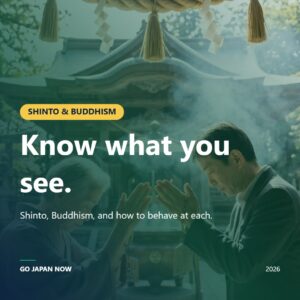
Religion in Japan 2026 — Shinto, Buddhism & Spiritual Traditions Explained